Optimization
Because every language is lowered into the same algebra, a query
can be optimized holistically: the optimizer neither knows nor cares which
language produced which part of the plan. A filter written at the end of an SQL
query can end up pushed deep into a Cypher subtree that came from a nested
LANG block, because to the optimizer both are just operators in one tree.
DortDB ships a rule-based optimizer. Cost-based optimizers generally do better, but they need statistics about the data. DortDB sources are schema-less by design and no statistics are collected, so instead the optimizer is an ordered, extensible set of rewrite rules. Each rule recognizes a pattern in the plan and replaces it with an equivalent, cheaper subtree.
The Showcase demo lets you toggle and reorder individual rules and watch the logical plan change, the quickest way to build intuition for what each rule does.
This page describes the built-in rules. To write your own rule for a custom operator, see Optimizer Rules; for the practical configuration knobs (indices, hash joins, rule ordering), see Indexing & Performance.
Optimizer-only plan operators
Three operators exist purely to give the optimizer better targets. They are not
part of the theoretical algebra (a plan is complete without them) but they
enable substantial speedups: IndexScan,
IndexedRecursion, and
BidirectionalRecursion. See the
Operator Reference for their
signatures and semantics.
The rules, in default order
The defaultRules
set applies the following rules in this order. Order matters: several rules
exist to create patterns that a later rule can exploit.
Unnest Subqueries
Finds Calculations that contain a safe
nested subquery and lifts the subquery out in front of the operator as a
ProjectionConcat, replacing it in the
calculation with a plain reference. A subquery is safe when it produces at most
one value and is always evaluated, so (SELECT number FROM t) + 5 is unnested,
but val IN (SELECT number FROM t) is not (the containing operator accepts a
sequence). Unless the subquery is guaranteed to return a value, the
ProjectionConcat is made outer.
This rewrite does not speed anything up on its own; it exposes the subquery to the rules below, which can turn it into a join.


A subquery inside a Selection's
Calculation is pulled out as an outer
ProjectionConcat.
Merge To/From Items
A MapFromItem sitting directly on top of a
MapToItem (or vice versa) is redundant. Such pairs
appear routinely after query rewrites and language switches. When
MapFromItem is the source and both operators'
keys match, both operators are removed outright; when
MapToItem is the source, they collapse into a
single-attribute Projection. The only exception
is when the source MapToItem key is the
Symbol(allAttrs). In that
case, the merge is skipped.


Subsequent matching MapToItem and
MapFromItem are removed.


A MapFromItem and a
MapToItem collapse into a single-attribute
Projection.
Pushdown Selections
A Selection reduces cardinality, so it pays to
evaluate it as early (as close to the leaves) as possible. This rule moves
Selections down the tree, with the constraints
needed to preserve meaning:
- Past
OrderByandDistinctit always moves freely. - Past set operators (
Union,Intersection,Difference) it is duplicated into both branches. - Past a
Projectiononly if the predicate does not depend on newly computed attributes, and only if the required renaming is safe (no variable shadowing); this is exactly what the attribute rename checker verifies. - Into a
Join,CartesianProduct, orProjectionConcatbranch that contains all the attributes the predicate needs, but never into the null-padded side of an outer join.
To avoid one un-pushable Selection blocking a
whole chain behind it, the rule considers the entire chain of stacked
Selections at once and pushes down only the parts
that are eligible.


A Selection duplicated across a set operator.


A Selection pushed below a
Projection (with its predicate renamed to
match).
ProjectionConcat → Join
A ProjectionConcat whose mapping does
not depend on the surrounding row (an uncorrelated subquery) is equivalent
to a CartesianProduct. If the
ProjectionConcat is outer, it becomes a
left outer Join instead. This turns the subqueries
unnested above into ordinary relational operators that later rules and the
executor can handle efficiently.


An uncorrelated, non-outer
ProjectionConcat becomes a plain
CartesianProduct.
Products → Joins
Merges a Selection with the
CartesianProduct beneath it into a single
Join, moving the predicate into the join condition.
When the Selection cannot be pushed into either
branch (because it references attributes from both), this is the rewrite that
still makes it useful. Applied to an existing Join, it
simply adds another condition rather than combining them into one.


A Selection over a
CartesianProduct that depends on both
branches folds into the Join condition.
Join Indices
The first half of the two-step index handling (described in
Secondary indices below). It looks for a
Join whose source side is an indexable data source and
whose conditions match a registered index, and rewrites it into a
ProjectionConcat shaped so the next rule
can turn the source into an IndexScan. In practice
the matched side may also carry chains of
Selections, OrderBys,
and Projections; index matching sees through
renames and ignores newly computed attributes.


A Join whose condition matches an index on its source
becomes an indexable ProjectionConcat.
Index Scans
The second half: a filtered TupleSource or
MapFromItem-wrapped
ItemSource whose
Selection matches a registered index is replaced
by an IndexScan. The scan's access
Calculation feeds the matching values straight
into the index structure instead of scanning the whole source. Like
Selection pushdown, it considers whole
Selection chains at once.


A filtered TupleSource is replaced by an
IndexScan driven by an index accessor.
Merge Projections
The most involved built-in rule. It combines two stacked
Projections into one: unused attributes are
dropped, and computed attributes are inlined, but only when a computed
attribute is referenced once, so a potentially expensive calculation is never
duplicated. For example, π([x → a, x → b], π([calc(1+1) → x], ...)) is left
as-is, because merging would evaluate 1+1 twice.


Two Projection nodes collapse into one; the
intermediate attribute disappears.
Secondary indices
DortDB lets you register
custom index types. Because it targets
many data models, indexing is deliberately open-ended: any
Calculation that contains no subquery is
indexable. During optimization, registered indices are shown the access
expressions in the plan and decide whether they apply: a hash-table index might
require an equality check on one attribute, while a range index also handles
inequalities. Currently the first matching index wins; this selection lives in
the two replaceable rules above (Join Indices and
Index Scans), so it can be swapped for a smarter algorithm.
See an example below of how the two rules work together:
// DortDB programmatic configuration:
db.createIndex(['t2'], ['a + b / 2'], MapIndex);
SELECT t1.foo, t2.bar FROM t1
JOIN t2
ON t2.a + t2.b / 2 = t1.id
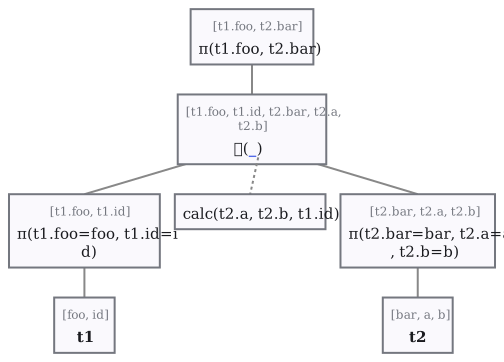
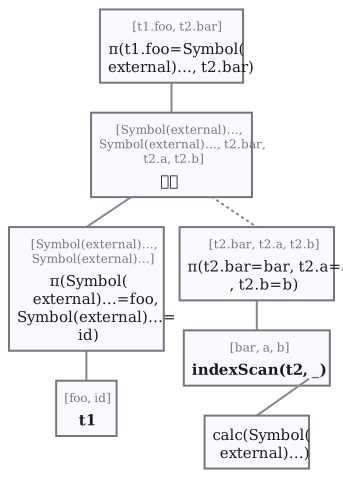
A complete example of the two-step index handling: a
Join is rewritten into a
ProjectionConcat combined with an
IndexScan as the source.
This design is what lets Cypher accelerate graph traversal. Graph steps are
lowered into Joins across node and edge sources, which
by themselves ignore the underlying structure. The Cypher
ConnectionIndex
detects those Joins via the data adapter's
isConnected
condition and routes them through the adapter's neighbor-lookup methods instead.
The index stores nothing itself (it is a thin wrapper over the adapter) and it
is what makes IndexedRecursion and
BidirectionalRecursion possible for
graph queries.
Calculation building & language-specific rewrites
Two more optimizations happen outside the rule list.
Constant folding occurs while
Calculations are built: a
pure function whose arguments are all constants is evaluated once at plan time
and replaced by its result, avoiding redundant work at execution time.
Because all languages share one algebra, optimizations that target a single
language are rare; it is usually better to write a rule that applies
universally. The exceptions live in the language packages, not the core. SQL,
for instance, rewrites quantified comparisons during plan building: a
> ALL (...) or similar subquery is replaced by an aggregation over the
subquery, e.g.
SELECT x FROM a WHERE x < ALL (SELECT y FROM b)
-- is evaluated as:
SELECT x FROM a WHERE x < (SELECT min(y) FROM b)